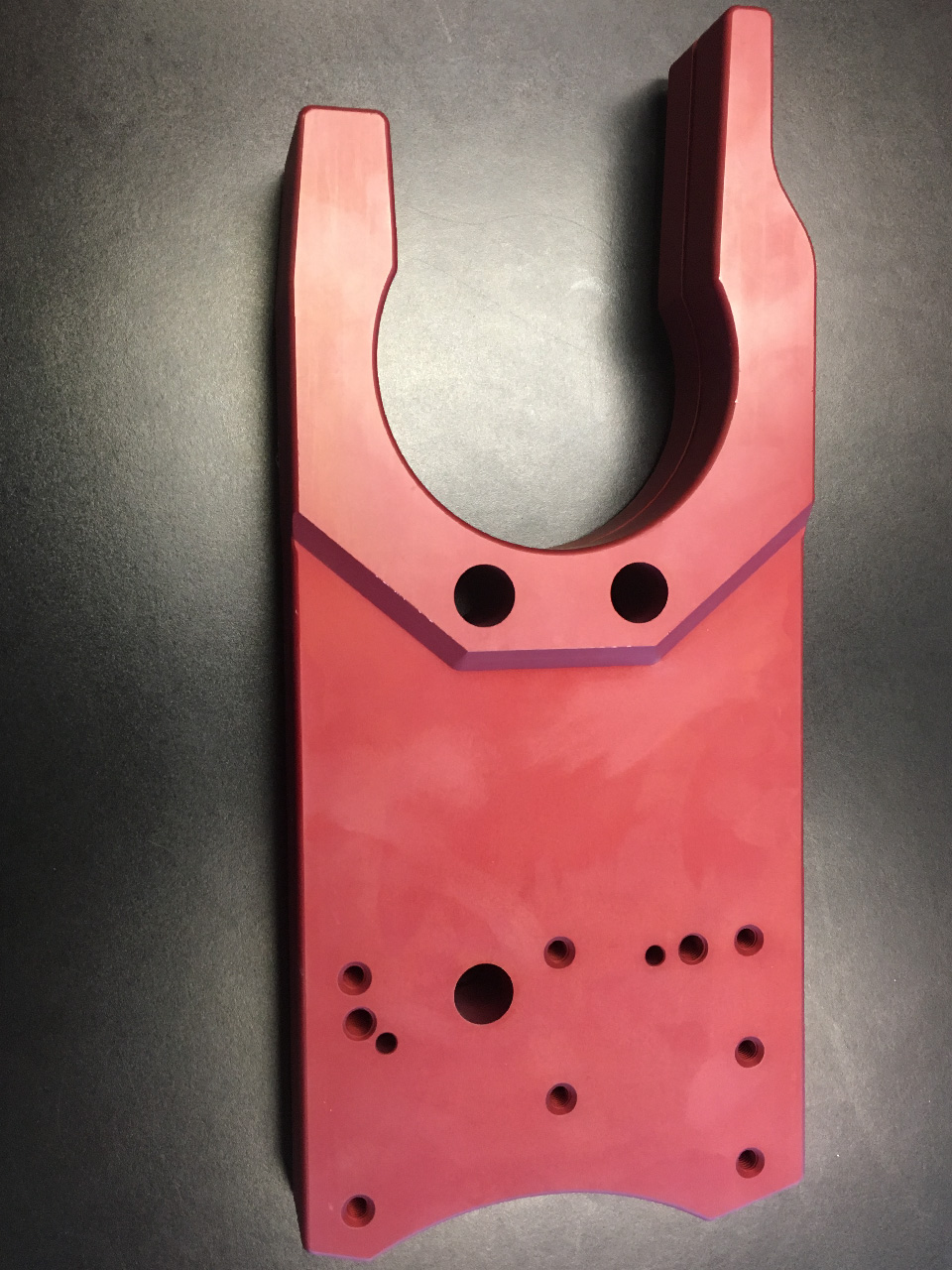
Why Brightly Colored Sawguides Undermine Sawmill Performance: A Technical Explanation
Every fall, our industry enters its busy season. Trade shows, conventions, and product showcases fill the calendar, giving manufacturers a chance to present new ideas and mills a chance to evaluate them. Yet year after year, one trend continues to stand out for all the wrong reasons: brightly colored sawguides.
Anyone familiar with my past writing knows I care deeply about sawguide quality. Accurate, durable sawguides are one of the simplest ways to improve sawmill productivity. So when I walk into a trade show and see red, blue, green, black or gold sawguides lined up on display tables, it raises a serious concern — not because of the color itself, but because of what that color represents.
—
Cosmetic Anodizing vs. Engineering Hardcoat Anodizing: The Technical Reality
Brightly colored sawguides are almost always produced using cosmetic anodizing, a process designed for appearance rather than durability. Cosmetic anodizing typically produces a coating thickness of 0.001 inches (one thousandth). It looks attractive, it’s inexpensive, and it’s easy to apply.
By contrast, engineering hardcoat anodizing — the correct process for industrial sawguides — produces a coating thickness of up to 0.005 inches (five thousandths). This is a fundamentally different class of surface treatment engineered for:
· Wear resistance
· Dimensional stability
· Abrasion protection
· Long-term performance under load
Engineering hardcoat anodizing only comes in one color: Gray
If a sawguide is any color other than gray or a shade of gray but not black, it is almost certainly cosmetic anodizing — and therefore not suitable for the mechanical demands of a sawmill.
—
Why Cosmetic Anodizing Fails in Industrial Environments
Cosmetic anodizing is intended for decorative consumer products, not components exposed to continuous friction, heat, and mechanical stress. In a sawmill, sawguides face:
· Constant abrasive wear
· Vibration
· Heat cycling
· Contaminants such as pitch, dust, and lubricants
A 0.001” cosmetic coating simply cannot withstand this environment. It wears rapidly, leading to:
· Loss of guide accuracy
· Increased saw deviation
· Reduced lumber quality
· More frequent guide replacement
· Higher operating costs
A 0.005” engineering hardcoat anodizing coating maintains its geometry far longer, protecting both the accuracy and the quality of the cut.
—
“Customers Want Bright Colors” — A Misguided Justification
Some vendors claim they are “giving customers what they want” by offering colored sawguides for easy identification. Differentiation is a legitimate need — many mills run dozens of guide sizes — but color is not the correct solution.
Better alternatives include:
· Clear labeling
· Engraved size markings
· Colored inserts
· RFID or barcode identification
These methods preserve durability while still supporting operational clarity.
The real reason cosmetic anodizing persists is simple:
It’s cheaper to produce and easier to sell.
But what’s cheaper for the manufacturer often becomes more expensive for the sawmill.
—
The Manufacturer’s Responsibility
A manufacturer’s job is not just to take an order — it’s to ensure the customer receives a product that performs as required. Selling cosmetic anodized sawguides into industrial environments is equivalent to knowingly selling a component that will fail prematurely.
As I wrote years ago:
“Cosmetic anodizing is MUCH cheaper to apply… It is not durable at all!”
That remains true today.
—
A Simple Rule for Sawmills
If a sawguide is not gray or a shade of it but not black, it is almost certainly not engineering hardcoat anodizing.
And if it is not engineering hardcoat anodizing, it will not deliver the durability, accuracy, or performance your mill depends on.
—
Final Thoughts
The sawmill industry deserves better than decorative components disguised as industrial tools. As mills push for higher productivity, tighter tolerances, and world-class performance, the quality of foundational components like sawguides matters more than ever.
Brightly colored sawguides may look appealing at a trade show, but in real production environments, they simply do not belong.
Author: Udo Jahn
Do you want the next article delivered to your Inbox? Subscribe here for ideas and tips on getting the most out of your mill.