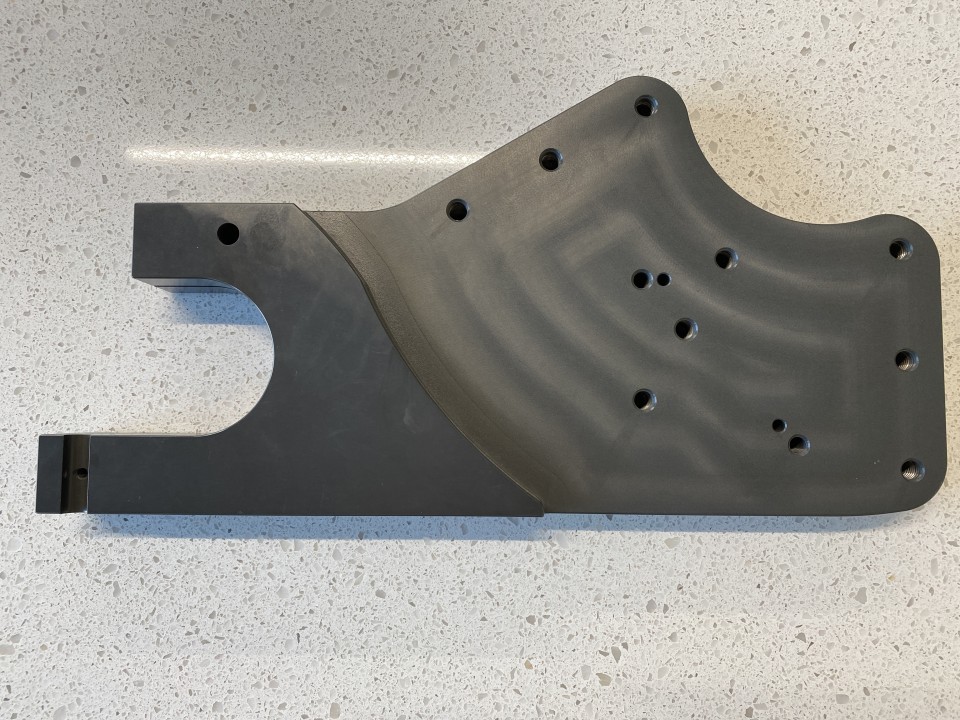
In filing rooms across the industry, the same question comes up again and again:
“We’ve got thicker aluminum saw guides on the shelf. Can you machine them down to a smaller size?”
It’s a fair question. Saw guides are not inexpensive, and mills are always looking for ways to stretch maintenance budgets. But the process of remachining a hard‑coat anodized aluminum saw guide is far more complex—and far more risky—than most people realize. Before deciding whether to repurpose an existing guide, it’s worth examining what actually happens during the remachining process and why the results often fall short of expectations.
Stripping the Hard Coat: Where the Problems Begin
Any saw guide that has been properly engineered hard-coat anodized must first be stripped before it can be remachined. This is done using an acid bath.
The challenge lies in the nature of engineering hard‑coat anodizing itself. Roughly half of the anodized layer sits above the aluminum surface, while the other half penetrates below it. Removing the anodizing means removing aluminum—there is no way around it.
This creates two immediate issues:
- Loss of material thickness, which can make it very difficult for small reductions in thickness.
- Loss of true surfaces, because acid does not remove anodizing uniformly.
Once the surfaces are no longer true, the guide’s accuracy is compromised before any machining even begins.
Trueing the Guide: A Critical but Often Impossible Step
After stripping, the guide must be trued—its faces brought back to a state of flatness and parallelism. This is essential for maintaining the tight tolerances required for accurate sawing.
However, because material has already been lost in the acid bath, achieving those tolerances becomes extremely difficult. In many cases, it is simply not possible to true the guide without pushing it out of specification, which means not meeting the tightest accuracy tolerances.
The consequences of running an out‑of‑tolerance saw guide are well known:
- Reduced sawing accuracy
- Increased downtime
- Inconsistent lumber
- Lower recovery
A remachined guide, even under ideal conditions, will never match the precision of a guide machined from new stock.
Reanodizing: The Final-and Most Dangerous-Step
If the guide has been stripped and remachined, it must be reanodized. This process involves:
- Removing all metal inserts
- Submerging the guide at freezing temperatures
- Running approximately 600 volts and 200 amps through the aluminum to rebuild the engineering hard‑coat layer
Any foreign metal left behind—which acts as something like a lightning rod and gets very hot —can cause the aluminum to erode during anodizing. The result is dramatic: the material appears to melt away, leaving the guide unusable.
This failure mode is not theoretical. It happens, and when it does, the guide is scrap.
So, Can Saw Guides Be Remachined?
Technically, yes. But the more important question is whether they should be.
Remachining introduces significant risks:
- Loss of material making some small reductions impossible
- Inability to true surfaces within tolerance
- Reduced accuracy and increased downtime in the saw mill
- Potential for catastrophic failure during reanodizing and losing the sawguide anyway
- Ultimately, the likelihood that the guide will need to be replaced/scrapped anyway is increased.
In most cases, remachining is a textbook example of false economy. The short‑term savings are quickly erased by long‑term losses in performance, reliability, and lumber quality. The losses can be very significant!’re worth the investment every time.
The Better Investment
Saw guides play a critical role in edger performance. Accuracy is not optional—it is foundational. For mills seeking consistent lumber, reliable operation, and maximum recovery, the most cost‑effective choice is also the simplest:
Start with new, properly machined, properly hard-coat anodized aluminum saw guides that are +/-0.0002” accuracy on the target dimension.
They deliver the accuracy and durability the process demands, and they pay for themselves many times over through improved uptime and better lumber.
Author: Udo Jahn